 简体中文
 English

How Do You Size a Winter Battery Bank for an Off-Grid System?
Winter battery bank sizing is the process of calculating how much battery capacity an off-grid solar system needs to carry its loads through cloudy or snow-covered days when photovoltaic output is low. The result is expressed in amp-hours (Ah) or kilowatt-hours (kWh), and it sets how many days the system can keep running without meaningful solar generation. The same method serves campervans, boats, remote households and telecom sites.
Three Inputs Drive the Whole Calculation
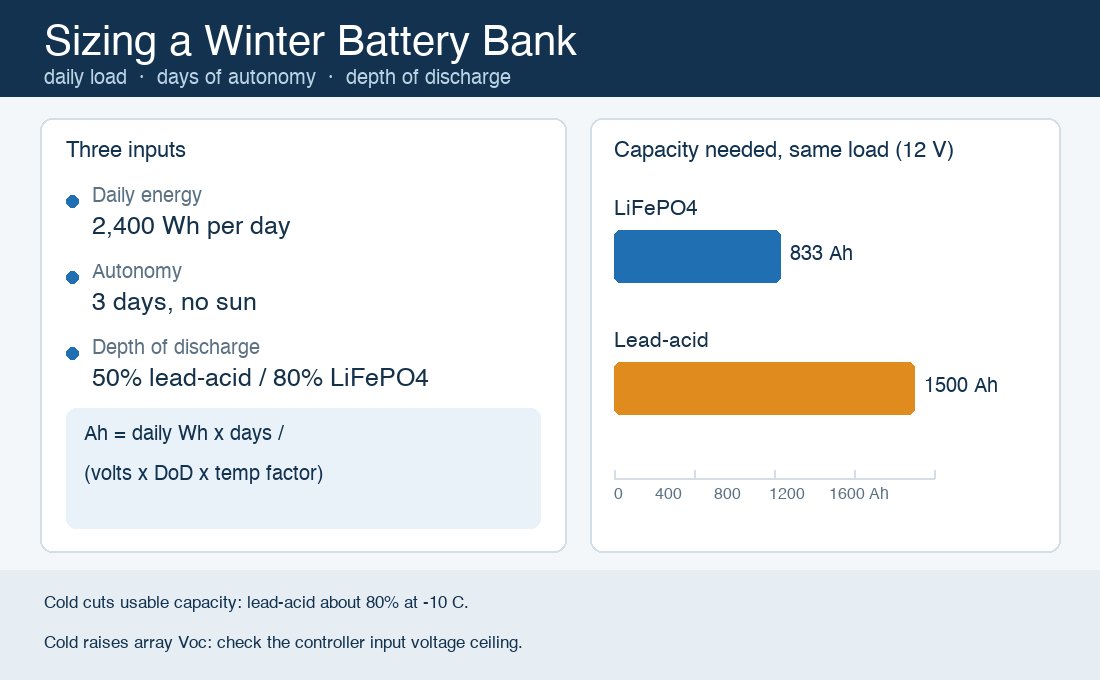
Winter sizing needs only three inputs: daily energy consumption, days of autonomy, and the depth of discharge the battery allows. Once these three values are fixed, the capacity follows from arithmetic alone and does not depend on brand or price.
Daily energy consumption is the sum of each load's rated power multiplied by its actual running hours, plus the losses inside the inverter. A pure sine wave inverter typically loses three to eight percent of its rated power to no-load and conversion losses, and the share is higher on small models.
| Input | Meaning | Typical value | Winter adjustment |
|---|---|---|---|
| Daily energy | Energy all loads draw in one day | Rated power times hours, summed | Add 20 to 40 percent for lighting and heating |
| Days of autonomy | Days the system must run without sun | Two to three days in mild climates, three to five in cold ones | Use the upper end where snow persists |
| Depth of discharge | Share of capacity that may be used | 50 percent lead-acid, 80 percent LiFePO4 | Reduce by a further 10 percent in cold sites |
| Temperature factor | Usable capacity lost to cold | 1.0 at 25 degrees Celsius | About 0.8 for lead-acid at minus 10 degrees Celsius |
The Formula and a Worked Example
The answer first: capacity in amp-hours comes from the expression below, and multiplying by system voltage and dividing by one thousand converts it to kilowatt-hours.
Capacity (Ah) = daily energy (Wh) x days of autonomy / (system voltage (V) x depth of discharge x temperature factor)
Example one: a campervan uses 2,400 Wh per winter day on a 12 V system with a LiFePO4 bank, a depth of discharge of 0.8, a temperature factor of 0.9 at minus 10 degrees Celsius, and three days of autonomy. The expression gives 2,400 x 3 / (12 x 0.8 x 0.9), which is about 833 Ah. In practice the bank is rounded to 840 Ah, for instance four 210 Ah batteries in parallel.
Example two: the same load on lead-acid batteries with a depth of discharge of 0.5 and a temperature factor of 0.8 gives 2,400 x 3 / (12 x 0.5 x 0.8), or 1,500 Ah. The gap between the two results shows that depth of discharge and the temperature factor move the answer more than nameplate capacity does.
Cold Affects Lead-Acid and LiFePO4 Differently
Usable capacity in a lead-acid battery falls roughly linearly with temperature. The common industry rule of thumb is about one percent of capacity lost for every degree Celsius below 25. LiFePO4 has a wider discharge window and still delivers current at minus 20 degrees Celsius, but usable capacity drops as well, and charging below zero degrees Celsius is not permitted.
That difference shapes the design. A lead-acid bank must carry a larger capacity margin, while a LiFePO4 bank needs its attention on warming the cells before charging, because extra capacity cannot be filled at freezing temperatures.
| Chemistry | Recommended depth of discharge | Usable capacity at minus 10 degrees Celsius | Cold charging limit |
|---|---|---|---|
| Lead-acid, including gel | 50 percent | About 80 percent of nameplate | Low-current charging allowed, voltage must be controlled |
| LiFePO4 | 80 percent | About 85 to 90 percent of nameplate | Charging blocked below zero degrees Celsius |
Insulation and Location Set the Real Usable Capacity
Insulating the battery compartment costs less than adding capacity. The following practices are well established in field installations.
- Mount the bank off the floor and add a plywood or foam base, so heat is not conducted into the ground.
- Keep the compartment ventilated while shielding it from direct cold airflow; charging produces heat and, in flooded lead-acid, gas.
- Below minus 10 degrees Celsius, fit a thermostatically controlled heating pad switched by the battery management system.
- Shorten the cable run from bank to inverter and increase conductor size, because resistance rises in cold weather and amplifies voltage drop.
Matching the Controller and Inverter to Winter Conditions
Cold weather raises the open-circuit voltage of photovoltaic modules. For crystalline silicon the voltage temperature coefficient is about minus 0.3 percent per degree Celsius, so at minus 10 degrees Celsius the open-circuit voltage sits roughly ten percent above its 25 degree value. Anyone specifying an MPPT solar charge controller must check the input voltage ceiling against that rise, or an unloaded array on a cold morning can trip over-voltage protection.
An inverter charger that combines controller and inverter in one enclosure shortens the DC wiring and suits space-constrained vehicle and small off-grid installations. A dedicated alternator charger can top up the auxiliary bank while the vehicle is driving, which helps when winter sun is scarce. A display panel that reads battery voltage and remaining capacity makes it straightforward to judge whether the winter reserve is sufficient without adding separate instruments.
Frequently Asked Questions
My winter figure is much larger than the summer one. Must I size for winter?
It depends on whether the load stays constant all year. Where winter loads are clearly higher, size for winter. Where the load is unchanged and only the sun is weaker, keep the bank and add module capacity or extend days of autonomy instead.
LiFePO4 cannot charge below zero. How should the system handle that?
A battery management system with low-temperature protection opens the charge circuit below zero degrees Celsius. The controller then reduces charge current, or a heating pad raises cell temperature above zero before charging resumes. Confirm during design whether the battery includes built-in heating.
Does a larger bank require a different inverter?
Capacity alone does not dictate a new inverter, but the input voltage window and the maximum charge current must be checked. A larger bank wants more charge current, and insufficient charging capacity lengthens recharge time considerably.
If you are planning a winter battery bank for a campervan, a boat or an off-grid cabin, send us your daily energy figure, the lowest ambient temperature and the days of autonomy you need. LECOOVO operates a 4,000 square metre production base in Zhongshan, covers 300 W to 6,000 W, holds CE, UL, SAA and CCC certification, and supports OEM/ODM work. Please contact us for sizing advice and matched system proposals.
 How to Wire Solar Panels Facing Different Directions
 How Long Does a DC-to-DC Charger Take to Charge an Auxiliary
How Do You Size a Winter Battery Bank for an Off-Grid System
 Can an Inverter Run a Refrigerator? Starting Power and Runti