 简体中文
 English

How Long Does a DC-to-DC Charger Take to Charge an Auxiliary Battery?
How long a DC-to-DC charger takes to charge an auxiliary battery is the number of hours needed, while the vehicle is running, to raise the auxiliary battery from its present state of charge to the target level using power converted from the alternator and starter battery. The time depends mainly on the amp-hours that must be replaced, the charger output current and the battery chemistry. The estimate is used in camper van, overland vehicle and caravan power system design.
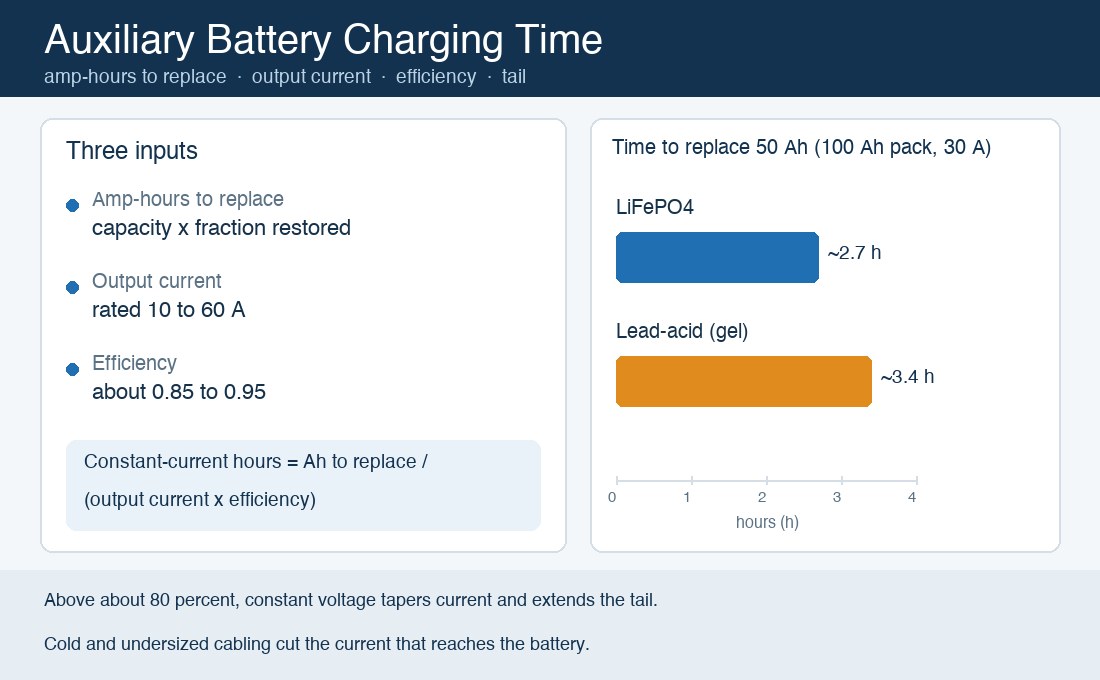
What Determines Auxiliary Battery Charging Time
Answer first: charging time is set by four quantities — the amp-hours to replace, the actual charger output current, conversion efficiency and how quickly the battery tapers current in the constant-voltage stage. The first three can be estimated with a formula; the fourth decides how long the final stage takes.
Amp-hours to replace equal nominal capacity multiplied by the fraction of charge that must be restored. A 100 Ah battery going from 20 percent to full needs about 80 Ah; going from 50 percent to full needs about 50 Ah. A DC-to-DC charger is rated for its constant-current output, and the current actually reaching the battery is reduced by cable resistance and voltage drop.
| Input | Meaning | Typical value | Effect on time |
|---|---|---|---|
| Amp-hours to replace | Capacity times the fraction restored | 20 to 100 Ah | Direct: more energy takes longer |
| Output current | Rated constant-current output | 10 to 60 A | Inverse: higher current is faster |
| Efficiency | Conversion and wiring losses | about 0.85 to 0.95 | Lower efficiency slows the tail |
| Charge acceptance | How fast current tapers at constant voltage | varies by chemistry and temperature | Sets time for the last 20 percent |
How to Estimate Charging Time from Amp-Hours and Current
Answer first: constant-current time equals amp-hours to replace divided by output current and then by efficiency; total time adds a constant-voltage allowance. A formula gives an order of magnitude, so a margin is advisable.
Formula: constant-current hours = amp-hours to replace / (output current in amps x efficiency). For a rough check, divide amp-hours by current for a lower bound, then add about 20 percent.
Example one: a 100 Ah LiFePO4 auxiliary battery going from 20 percent to full needs about 80 Ah. With a 30 A DC-to-DC charger at 0.9 efficiency, constant-current time is about 80 divided by 27, close to three hours; adding roughly one hour of absorption gives about four hours in total.
Example two: a 100 Ah lead-acid auxiliary battery going from 50 percent to full needs about 50 Ah. With the same 30 A charger at 0.9 efficiency, constant-current time is about 1.9 hours; because lead-acid absorption takes longer, the total is roughly three to four hours.
Why the Last 20 Percent Takes Longer
Answer first: a DC-to-DC charger, like most charging methods, uses constant current followed by constant voltage. Above roughly 80 percent state of charge, current tapers, so replacing the last 20 percent can take almost as long as the first part.
During constant current, the charger delivers its rated current and state of charge rises quickly. In constant voltage, voltage is held steady while battery voltage climbs, so the gap shrinks and current falls. This protects cells and plates from overcharge, at the cost of a slower tail. Charging from 20 to 80 percent may take two or three hours, while 80 percent to full can add another one or two hours.
How Battery Chemistry and Temperature Change the Time
Answer first: LiFePO4 usually has a shorter constant-voltage stage than lead-acid and reaches full sooner under the same conditions. Cold reduces charge acceptance and extends time, and LiFePO4 should not be charged below 0 C unless the battery includes heating.
| Battery type | Constant-current stage | Constant-voltage tail | Cold behaviour |
|---|---|---|---|
| LiFePO4 | Accepts higher current with a flat platform | Shorter, around one hour | Charging below 0 C is not advised |
| Lead-acid (including gel) | Current limited as voltage rises | Longer, around one to two hours | Reduced acceptance, longer time |
Temperature also affects the input side. In winter, available output from the starter battery and alternator falls, and some chargers then limit current. The power reaching the auxiliary battery sits below the rated figure, so this reduction belongs in any estimate.
How to Shorten Auxiliary Battery Charging Time
Answer first: reduce time by raising the current that actually reaches the battery and by lowering the amp-hours that must be replaced. Raising the charger rating alone, without checking supply and cable size, rarely produces a matching gain.
- Match output current to battery capacity, and confirm the alternator and starter battery can sustain that current at driving speed.
- Shorten the cable run from charger to battery and size conductors for the current to reduce voltage drop.
- Use temperature compensation or a heated battery so the pack returns to an allowed charging temperature before top-up.
- Add solar as a complement: on sunny days an MPPT solar charge controller feeds power from roof panels, and the DC-to-DC charger continues while driving, so neither source carries the full load alone.
If the system also includes an inverter charger, check that both its output and the DC-to-DC charger match the auxiliary battery and connected loads. Otherwise the estimate rests on output the system cannot sustain.
Frequently Asked Questions
How much charge does a DC-to-DC charger add in one hour?
Using the estimate above, a 30 A charger at 0.9 efficiency adds roughly 27 Ah in one hour, and the real figure falls as battery voltage rises. Near full charge, the amount added in the constant-voltage stage is noticeably smaller.
Is charging at idle as fast as charging while driving?
Usually not. At idle the alternator turns more slowly and delivers less power, so the DC-to-DC charger may limit current. Base estimates on normal driving speed and allow a margin for idle conditions.
Does a larger auxiliary battery always take longer to charge?
Not always. If the depth of discharge is the same, yes, because more amp-hours must be replaced. A larger battery that is only lightly discharged may need fewer amp-hours than a smaller, deeply discharged one, so the time still follows the energy that must be restored.
LECOOVO builds power products from 300 W to 6000 W at a 4000 square metre facility in Zhongshan, with CE, UL, SAA and CCC certifications in scope, and supports OEM/ODM cooperation. To estimate a charging plan for your battery capacity and driving pattern, contact us for a selection proposal.
 How to Wire Solar Panels Facing Different Directions
How Long Does a DC-to-DC Charger Take to Charge an Auxiliary
 How Do You Size a Winter Battery Bank for an Off-Grid System
 Can an Inverter Run a Refrigerator? Starting Power and Runti