 简体中文
 English

How Do You Choose a Home Energy Storage Inverter?
A home energy storage inverter is a power electronics device that converts DC power from a battery bank into household AC power and back again, moving energy between the PV array, the utility grid and the battery. It is used for self-consumption of rooftop solar, time-of-use arbitrage and backup power during grid outages.
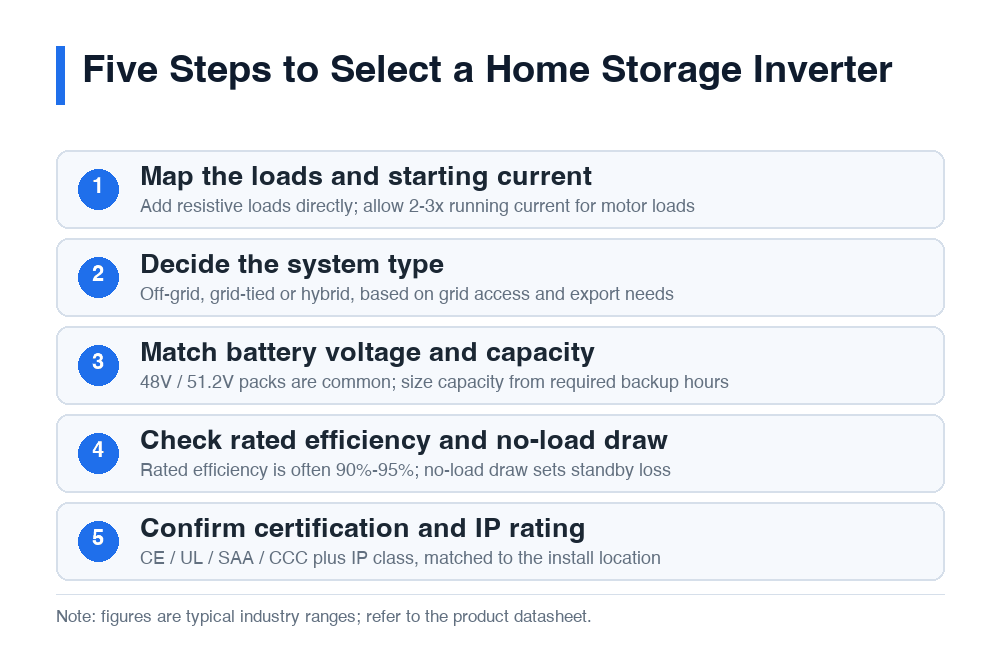
Step 1: List the loads before talking about wattage
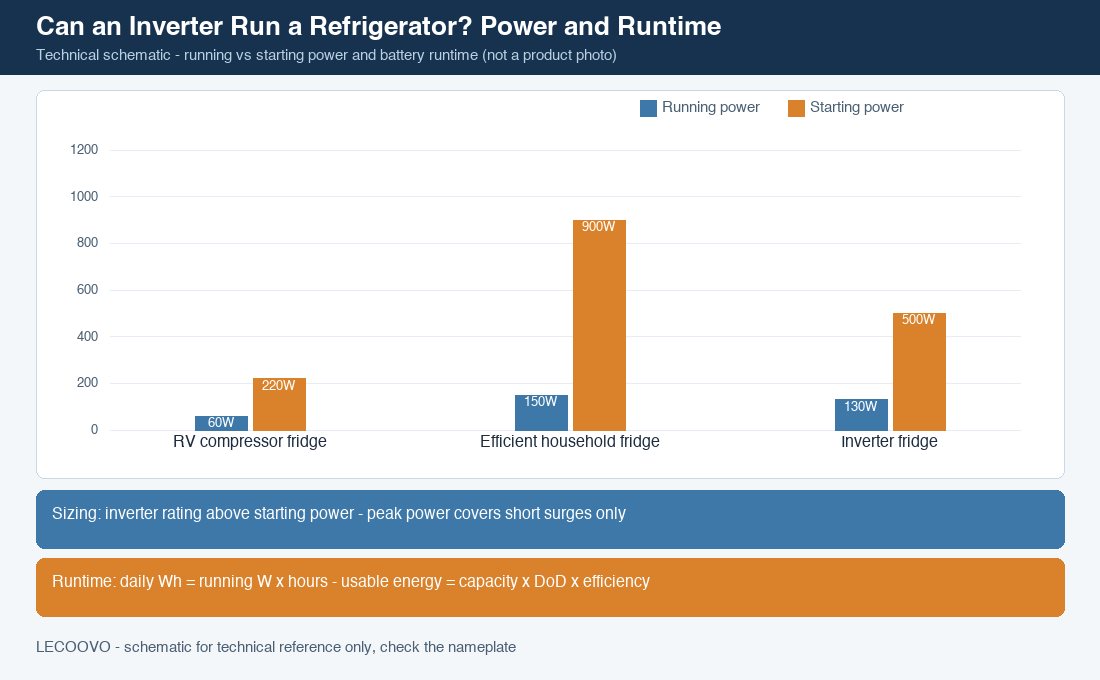
Selection starts with a load survey, not with a wattage figure. Split the appliances you want backed up into resistive and inductive loads. Lighting, kettles and rice cookers are resistive, so their rated power can be added directly. Fridge compressors, pumps and air-conditioner outdoor units are inductive, and their inrush current can reach two to three times the running current, so headroom has to be reserved for starting. A fridge rated at 150W may pull more than 500W for a moment when the compressor starts. Size the inverter on the nameplate figure alone and it will trip its overload protection on start-up.
Add 20% to 30% headroom once the list is complete. The headroom is not there to absorb peaks; it keeps the unit out of continuous full-load operation, where power devices run hotter, the fan runs faster and electrolytic capacitor life is derated further.
Step 2: System type and battery configuration
Home storage systems fall into three groups by their relationship with the grid. The type decides how every later parameter is derived, and getting it wrong means recalculating both power and battery.
| Type | Grid connection | Export to grid | Typical use |
|---|---|---|---|
| Off-grid | None | Not applicable | Areas without a grid, RVs, remote sites |
| Grid-tied | Yes | Supported | Stable grid, arbitrage-focused |
| Hybrid | Yes | Configurable | Backup plus export |
A hybrid unit is effectively a grid-tied inverter with an off-grid transfer stage. When the grid fails it switches to island mode, with a transfer time usually in the 10ms to 20ms range. Switched-mode loads generally ride through that gap, but equipment that is sensitive to any interruption still needs a UPS behind it.
Battery voltage sets the DC input window of the inverter. 48V and 51.2V are the two common levels in home systems: 48V usually pairs with 15-cell lithium iron phosphate or lead-acid strings, while 51.2V corresponds to 16 cells. Check that the DC input range covers the full span from full charge to cutoff, because the cutoff voltage of lithium iron phosphate drifts lower in cold conditions, and that point is easy to overlook.
Capacity is derived from the required backup time: battery capacity (kWh) is approximately backup power (kW) multiplied by backup hours, divided by depth of discharge and by inverter efficiency. For 3kW of backup load, 4 hours, a depth of discharge of 0.9 and an efficiency of 0.92, the result is about 14.5kWh, so rounding up to 15kWh is the safer choice.
Look at the charging side as well. If PV is expected to recharge the bank, the output current of the MPPT solar charge controller has to match battery capacity. Lead-acid banks are usually charged at 0.1C to 0.2C, lithium iron phosphate can take 0.5C, and a higher rate accelerates battery heating.
Step 3: Read efficiency and no-load draw separately
Rated efficiency is the conversion efficiency at rated load, and for home storage inverters it typically falls between 90% and 95%. Household loads rarely sit at that point, though. At night the unit may only carry a fridge, a router and standby devices, with a load ratio below 10%, and there light-load efficiency and no-load draw are what matter.
A unit with 15W of no-load draw consumes about 0.36kWh a day, or roughly 11kWh a month. At 40W the monthly figure approaches 29kWh. In a backup scenario that energy comes straight out of the battery, and the effect is more visible in winter when PV yield is low.
Efficiency figures also come in two forms. Peak efficiency describes a single operating point, while a weighted figure such as European efficiency is calculated across load levels and tracks real use more closely. When comparing datasheets, compare the weighted value first.
Step 4: Parallel capability, starting capability and thermal design
If one unit is not enough, check the parallel capability. Two to six units in parallel is common. Confirm whether capacity simply adds up or is distributed master-to-slave, and whether the parallel cables are included. Starting capability is expressed as a peak factor, typically twice rated power for 5 seconds and three times for 1 second; work back from that factor when pumps or compressors are on the load list.
Cooling is either natural convection or forced air. For fan-cooled models, confirm the clearance around the intake and exhaust. Inside a cabinet, leave at least 100mm above and below, otherwise recirculating hot air keeps the fan at high speed. If the unit sits near a bedroom, favour a model with large low-speed fans.
Step 5: Certification, ingress protection and supply capability
Check certification against the target market: CE for the European Union, UL for North America, SAA for Australia and New Zealand, CCC for China. Certification applies to specific models and power ratings, and adjacent ratings in one series do not always share a certificate.
Choose the IP rating from the installation environment. IP20 is sufficient in a dry indoor room, while garages and outdoor enclosures call for IP65. Above 2000m of altitude the unit must be derated, and the same applies above 40 degrees Celsius ambient; datasheets usually provide a derating curve to check against actual conditions.
For volume projects, supply capability matters too. LECOOVO operates a 4000 square metre production base in Zhongshan, covers 300W to 6000W, holds CE, UL, SAA and CCC certifications, and supports OEM/ODM customisation, including output configuration, panel printing and communication interfaces.
Frequently asked questions
Is a larger inverter always the better choice?
No. Stepping up one power class raises no-load draw and standby loss and lowers light-load efficiency. Headroom of 20% to 30% on the load survey is enough, and starting surges are covered by the peak factor rather than by rated power.
Can a storage inverter share an existing grid-tied array?
Yes, but the coupling method matters. DC coupling moves the array's DC side onto the PV input of the storage unit, which removes a conversion stage and gives higher efficiency. AC coupling keeps the existing grid-tied inverter and adds the storage unit on the AC side, which costs less to retrofit. Before either approach, check the array open-circuit voltage against the MPPT input limit of the storage unit.
Can 48V and 51.2V batteries be mixed in one system?
It is not advisable. The two levels use different cell counts, so full-charge and cutoff voltages differ. Mixing them creates circulating current between strings and interferes with BMS protection logic. One system should use one voltage platform, one batch and one capacity class.
Selection ends with a filled-in parameter sheet: load list, system type, battery voltage, capacity, efficiency, peak factor and IP rating, each checked against the supplier datasheet. LECOOVO offers pure sine wave inverter, MPPT solar charge controller, all-in-one storage units and DC-DC chargers, and supports custom output configuration, communication protocols and panel layouts. Please contact us for sizing advice and sample support.
 How to Wire Solar Panels Facing Different Directions
 How Long Does a DC-to-DC Charger Take to Charge an Auxiliary
 How Do You Size a Winter Battery Bank for an Off-Grid System
 Can an Inverter Run a Refrigerator? Starting Power and Runti