 简体中文
 English

What Do Inverter Fault Codes Mean and How Do You Diagnose Them?
An inverter fault code is a status number that the inverter's control chip records and displays on its LCD, LED indicator or buzzer when it detects an abnormal input voltage, output current, heatsink temperature or internal circuit condition; the code narrows the problem down to the input side, the output side or the thermal path, and it appears on pure sine wave inverters, inverter-chargers and vehicle-mounted models alike.
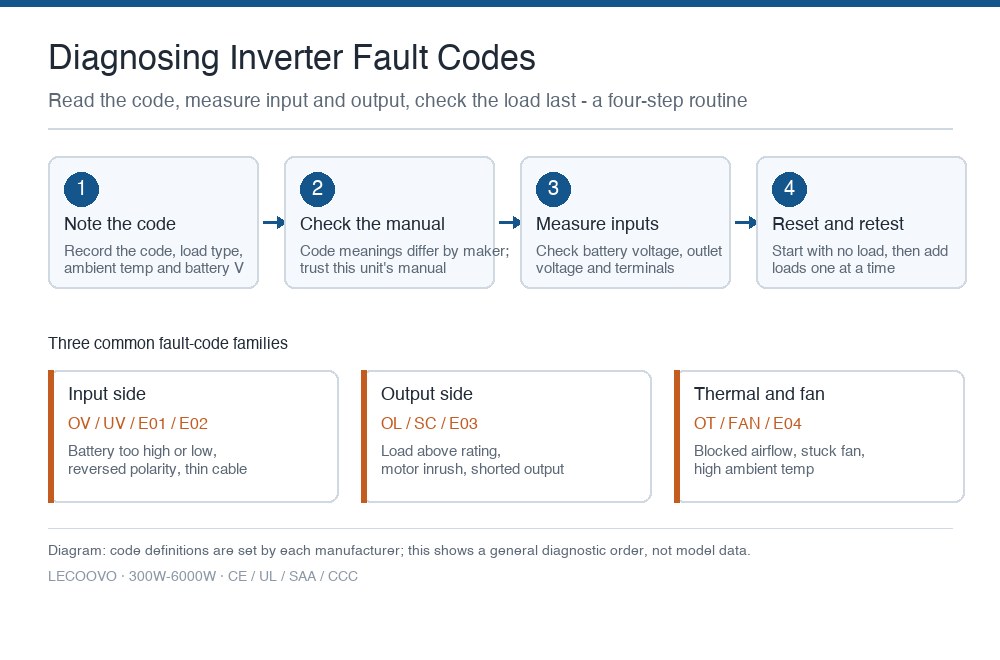
Code families are more reliable than numbers
Start with the conclusion: there is no mandatory, industry-wide fault code table for inverters. Each manufacturer defines the numbering in its own firmware, so the same number can point to a completely different part on two brands. Copying a code meaning from another brand is a common source of misdiagnosis.
Only the code families transfer reliably. Most makers keep the English abbreviations: OV for over-voltage, UV for under-voltage, OL for overload, SC for short circuit, OT for over-temperature and FAN for fan failure, sometimes combined with sequential numbers such as E01 through E09. When a code appears, first decide which family it belongs to, then confirm the exact definition in that unit's own manual. That path is more dependable than guessing from the number.
The table below groups the common code families by input, output and temperature, with the conditions that usually trigger them and what to check first. Voltages and temperatures are typical ranges for a 12V system and mainstream models; the actual thresholds on your unit are set by its nameplate and manual.
| Code family | Typical abbreviations | Typical trigger | Check first |
|---|---|---|---|
| Input over-voltage | OV / E01 | About 15-16V on a 12V system | Charging voltage and battery bank matching the model |
| Input under-voltage | UV / E02 | Cut-off near 10.5V on a 12V system | Battery state of charge, cable gauge, terminal voltage drop |
| Output overload | OL / E03 | Above 105%-110% of rating continuously; shutdown within seconds above 150% | Total load wattage and motor inrush current |
| Output short circuit | SC | Output loop impedance near zero | Water in the socket, damaged cable insulation, a shorted appliance |
| Over-temperature | OT / E04 | Heatsink around 65-75C | Fan speed, intake and exhaust clearance, ambient temperature |
| Fan failure | FAN | Loss of the speed feedback signal | Seized blades, loose connector, worn bearing |
The four-step diagnostic order
Order matters more than experience here. Collecting evidence before touching anything keeps a reproducible fault from turning into one you can no longer reproduce.
- Record the code and the symptoms: note the code number, the load type, the ambient temperature and the battery voltage, and photograph the display.
- Check the manual: confirm which part that number refers to on this unit, not on another brand.
- Measure with the power off: disconnect battery and loads, then measure the battery rest voltage, the terminal voltage drop and the resistance across the output socket.
- Reset and retest: start with no load, confirm the code stays away, then add one appliance at a time to find the trigger condition.
Overload codes: look at the load, then at how it starts
Overload is one of the more frequent service complaints. Most models set the continuous overload threshold at 105%-110% of rated power, and shut down within seconds above 150%. When a pure sine wave inverter drives an inductive load such as a motor or a compressor, the inrush current at start-up can reach three to five times the rating, so the protection can trip even when the running wattage looks fine.
Work in this order: disconnect every load and start the unit with no load to confirm the code clears; reconnect appliances one at a time and note which one brings the code back; for motor loads, use soft-start or staggered starting. If the code persists with nothing connected, suspect a short on the output side or a fault in the internal current-sense circuit, and send the unit in for service.
Over-temperature and fan codes: clean the path, then check the airflow
The over-temperature shutdown point is usually set between 65C and 75C at the heatsink, and internal temperature rises faster once ambient exceeds 40C. Fan codes usually come from a lost speed feedback signal, most often caused by dust-seized blades, a loose connector or a worn bearing. Clearing the duct, confirming the blades turn freely and checking that luggage or cartons are not blocking the vents solves a large share of over-temperature alarms.
Input-side codes: measure the battery first, then the cable
Under-voltage codes show up often in campervan and off-grid systems. A 12V lead-acid bank typically cuts off near 10.5V, while a lithium pack follows its BMS setting. Measure the battery rest voltage first, then the terminal voltage under load; a large gap points to undersized cable or oxidized terminals, and the resulting drop gets misread as a flat battery.
Over-voltage codes usually involve the charging path. If an MPPT solar charge controller is set to an equalization voltage that is too high once the bank is full, or if a DC-DC charger and a mains charger run at the same time, the input voltage is pushed up. An inverter-charger houses the controller and the inverter in one enclosure, so charging parameters and cut-off thresholds have to be checked in the same settings page, otherwise the unit can trip on over-voltage while it is still charging.
Frequently asked questions
It works again after a reset. Does it still need repair?
A single isolated event can be watched. If the same code returns twice or more within a week, the trigger condition is still present, and continued use makes the power devices absorb repeated stress; identify the code family first, then decide whether to return the unit.
Do E01 and E02 always mean a battery voltage problem?
No. The numbering is set by the manufacturer, and some models use E01 for an output short and E02 for over-temperature. Judge by whether the code family abbreviation matches your measured values, not by the number alone.
How do I read the code if the manual is lost?
First check whether the display also shows voltage, current or temperature, and work backwards from those readings. Then try a power-cycle reset and note whether the code appears with no load or only under load: a no-load code points to hardware, a loaded code points to load matching. If it is still unclear, give the manufacturer the model, the code, the load type and your measured voltages together.
LECOOVO operates a 4,000 square metre production base in Zhongshan, covers 300W-6000W, holds CE, UL, SAA and CCC certification, and supports OEM/ODM customisation. If you need help with selection, fault interpretation or custom development, contact us with your model and operating conditions.
 How to Wire Solar Panels Facing Different Directions
 How Long Does a DC-to-DC Charger Take to Charge an Auxiliary
 How Do You Size a Winter Battery Bank for an Off-Grid System
 Can an Inverter Run a Refrigerator? Starting Power and Runti