 简体中文
 English

How Do You Calculate MPPT Charge Controller Current?
An MPPT solar charge controller uses maximum power point tracking to convert solar panel output into the voltage a battery bank needs. The question most people ask is simple: how many amps will the array actually push into the batteries? Here is the short answer. Divide total array watts by the charging voltage, multiply by roughly 0.9, and you get the continuous current the controller has to carry.
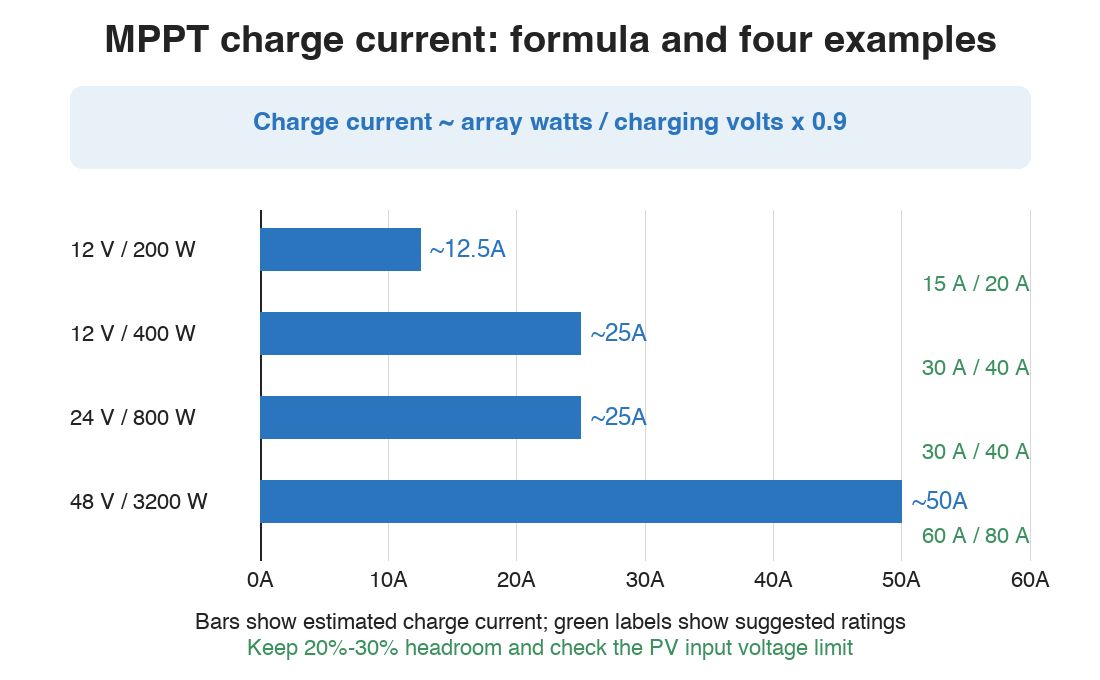
The formula for charge controller current
Charge current is approximately array watts divided by charging voltage, times 0.9. That 0.9 accounts for conversion losses. Most controllers run somewhere between 0.92 and 0.98 efficiency, so using 0.9 gives you a slightly conservative number. Charging voltage depends on the battery bank: about 14.4 V for a 12 V system, 28.8 V for 24 V, and 57.6 V for 48 V.
Take a 12 V system with 400 W of panels. 400 / 14.4 x 0.9 comes out near 25 A, so a 30 A or 40 A controller covers it. Some people divide 400 by 12 and get 33 A. That figure is too high. The controller will not fail because you oversized it, but you pay extra for amps you never use.
Why battery capacity is the wrong starting point
This is where the calculation often goes sideways. Amp-hours tell you how much energy a battery stores. They do not tell you the charging current. Array watts and system voltage set that current. The battery does impose a ceiling of its own: lead-acid types are often charged at roughly one tenth to one fifth of their amp-hour rating, while lithium batteries usually accept higher rates. Think of it as two separate checks. The panels set what is available, and the battery sets what it can take.
The same bank may also feed a pure sine wave inverter, but inverter loads do not change this calculation. Controller sizing follows the charging side only.
Sizing examples across system voltages
The table below uses the same 0.9 factor. Pick a controller whose continuous rating meets or exceeds the estimate, then add a little headroom.
| Bank voltage | Array watts | Estimated charge current | Suggested controller rating |
|---|---|---|---|
| 12 V | 200 W | about 12.5 A | 15 A or 20 A |
| 12 V | 400 W | about 25 A | 30 A or 40 A |
| 24 V | 800 W | about 25 A | 30 A or 40 A |
| 48 V | 3200 W | about 50 A | 60 A or 80 A |
Check voltage limits and derating too
One spec gets overlooked more often than current: the maximum PV input voltage. Open-circuit voltage rises in cold weather. If a string exceeds the controller's limit, the unit can be damaged. Build the temperature coefficient into your calculation, especially in cold climates. The rated current itself is quoted under specific thermal conditions. Inside a hot, poorly ventilated enclosure, usable current drops. Leaving 20 to 30 percent of headroom is a practical habit.
MPPT and PWM produce different currents
Given the same array, an MPPT controller converts excess array voltage into charging current. A PWM controller links the panels more directly to the battery, pulling panel voltage down and leaving some power unused. The bigger the gap between array voltage and battery voltage, the wider that difference becomes. An all-in-one inverter charger puts the controller and inverter in one box, which shortens wiring, but the current calculation stays the same. On a vehicle, a DC-DC charger handles alternator input while the array follows its own numbers.
Frequently asked questions
What size controller does a 100 W solar panel need?
On a 12 V bank, 100 / 14.4 x 0.9 is about 6 A, so a 10 A unit leaves room. On a 24 V bank the current roughly halves and a 5 A model is enough.
Will a higher-rated controller overcharge the battery?
No. The rating is a ceiling the controller can handle, not a current it forces into the battery. The battery draws what it needs. A larger unit costs more and leaves space for later expansion.
What happens with a small battery and a large array?
Check the battery's maximum accepted charge current first. If the array exceeds it, reduce the array size or choose a controller with current limiting. Otherwise the battery may heat up, lose electrolyte, or trip its protection.
LECOOVO (Yineng Precision) runs a 4000 m² production base in Zhongshan. Product power ranges from 300 W to 6000 W, with CE, UL, SAA, and CCC certifications, and OEM/ODM customization is available. If you are matching an array to a controller, contact us to talk through the numbers.
 How to Wire Solar Panels Facing Different Directions
 How Long Does a DC-to-DC Charger Take to Charge an Auxiliary
 How Do You Size a Winter Battery Bank for an Off-Grid System
 Can an Inverter Run a Refrigerator? Starting Power and Runti