 简体中文
 English

Can a Pure Sine Wave Inverter Run an Air Conditioner?
A pure sine wave inverter converts DC power from a battery bank into AC power with the same waveform as the utility grid, and it is widely used in RVs, off-grid solar systems, and backup power setups to run loads such as air conditioners and refrigerators. The short answer: yes, a pure sine wave inverter can run an air conditioner, provided its continuous rating covers the unit's running watts, its surge rating covers the compressor's starting surge, and the battery and cabling can deliver the required current.
Why Air Conditioners Are Hard to Start: Compressor Surge
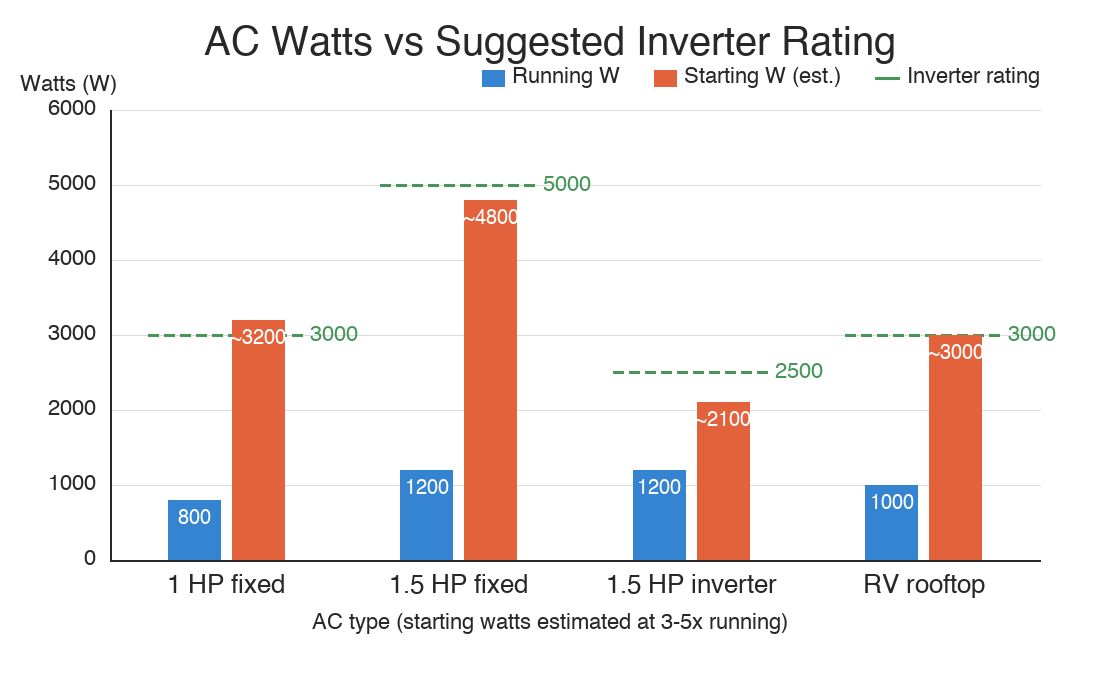
An air conditioner is a typical inductive load: its compressor motor draws far more current at startup than during steady operation. On a fixed-speed unit, starting power is usually 3 to 5 times the rated running power, and the surge lasts roughly 0.2 to 1 second. If the inverter's surge rating is too low, it trips overload protection and shuts down the moment the compressor kicks in. If the battery cannot supply enough current, the DC bus voltage sags and the inverter enters low-voltage protection. Inverter (variable-speed) air conditioners use soft starting, so their surge is much smaller and they are easier on the inverter.
Step 1: Find Running Watts and Starting Watts
Check the nameplate or manual for rated input power rather than cooling capacity. Typical figures: a 1 HP fixed-speed unit runs at about 700-900 W, a 1.5 HP unit at about 1000-1300 W, and RV rooftop units at about 800-1100 W. Estimate starting watts at 3 to 5 times running watts for fixed-speed models, or about 1.5 times for inverter models. If the nameplate only lists current, multiply current by rated voltage to get watts.
Step 2: Match the Inverter Rating
The rule of thumb: the inverter's continuous rating should be at least 1.3 times the air conditioner's running watts, and its surge rating should exceed the starting watts. The table below gives reference pairings:
| AC type | Running watts (W) | Starting watts (W) | Suggested inverter rating (W) |
|---|---|---|---|
| 1 HP fixed-speed | ~800 | ~2400-4000 | ≥3000 (surge ≥4000) |
| 1.5 HP fixed-speed | ~1200 | ~3600-6000 | ≥5000 (surge ≥6000) |
| 1.5 HP inverter-type | ~1200 | ~1800-2400 | ≥2500 (surge ≥3000) |
| RV rooftop AC (220V) | ~1000 | ~2500-3500 | ≥3000 (surge ≥4000) |
Step 3: Battery and Cabling Must Keep Up
A large inverter still fails if the battery cannot deliver the current. A 3000 W inverter at full load on a 12 V system draws over 250 A, where cable loss and heat become serious, so higher-power setups are better served by 24 V or 48 V systems. The battery's discharge rate must cover the inverter's maximum input current; lithium batteries generally handle high discharge currents better than lead-acid. Size cable cross-section to the current and keep runs short. If the system also has solar panels, an MPPT solar charge controller can replenish the battery, and a DC-DC charger can top up the auxiliary battery while driving.
Practical Tips to Reduce Starting Surge
First, prefer inverter-type air conditioners or RV units with soft starters. Second, switch off other heavy loads before starting the AC. Third, power up the inverter before turning on the air conditioner so they do not energize at the same moment. Fourth, clean the air filter regularly, since clogging raises running power. An all-in-one inverter-charger that integrates inversion, charging, and control in one enclosure also simplifies wiring and power matching, and is common in RVs and off-grid cabins.
Frequently Asked Questions
Can a pure sine wave inverter run a fixed-speed air conditioner directly?
Yes, as long as its surge rating covers the compressor's starting surge. For a 1 HP fixed-speed unit, choose a model rated at least 3000 W continuous and 4000 W surge, with adequate battery capacity.
Is it realistic to run an air conditioner on a 12 V system?
A small RV unit is borderline feasible, but the current is high and cable losses add up. For loads above 2000 W, a 24 V or 48 V system is more efficient and safer.
Can a modified sine wave inverter run an air conditioner?
It is not recommended. A modified sine wave makes the compressor motor run hotter and less efficiently, and some AC control boards may misbehave. Motor-driven loads call for a pure sine wave model.
LECOOVO (Yineng Precision) operates a 4000 m² production base in Zhongshan. Its pure sine wave inverter lineup covers 300 W to 6000 W with CE, UL, SAA, and CCC certifications, and OEM/ODM customization is supported. If you need sizing advice for air conditioner loads or a custom production run, feel free to contact us for a technical proposal.
 How to Wire Solar Panels Facing Different Directions
 How Long Does a DC-to-DC Charger Take to Charge an Auxiliary
 How Do You Size a Winter Battery Bank for an Off-Grid System
 Can an Inverter Run a Refrigerator? Starting Power and Runti