 简体中文
 English

Why Does Off-Grid Solar Output Drop in Winter?
Off-grid solar output in winter means the electricity an independent PV-plus-battery system actually delivers during the colder months, compared with what the same array produces in summer. Because no utility line backs the system up, that seasonal gap directly shrinks the usable energy on board an RV, a boat, a pasture pump, a telecom site or a remote cabin, so it has to be designed in rather than patched later.
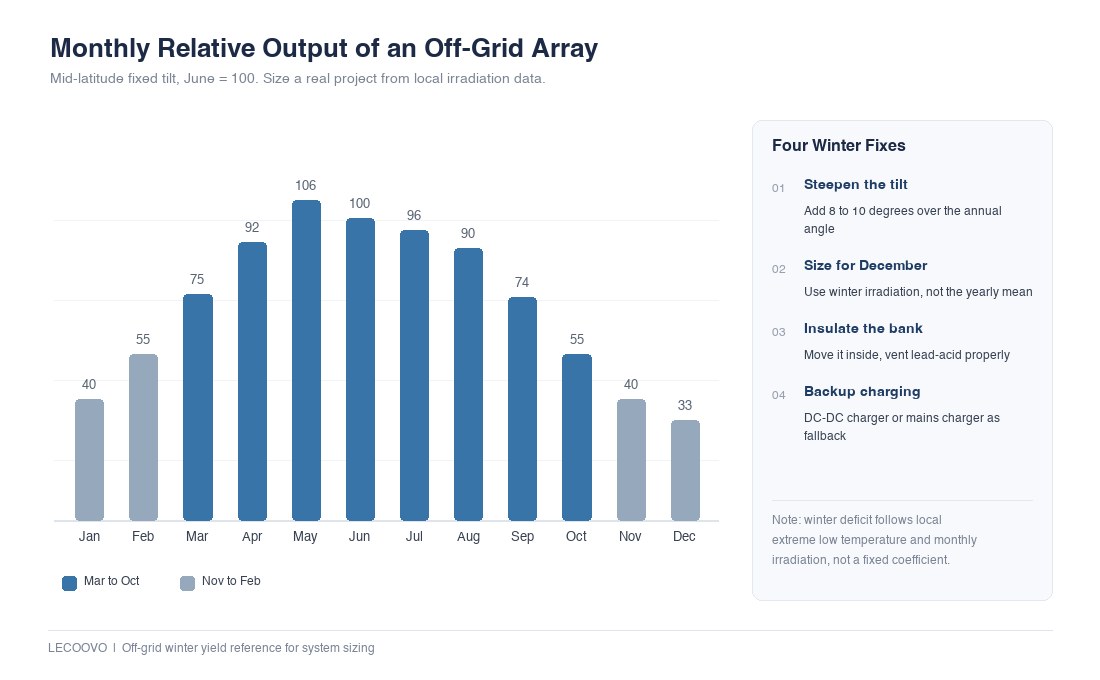
How much output is actually lost
Start with the answer: at mid latitudes in the northern hemisphere, a fixed off-grid array typically delivers only 40% to 60% of its June daily yield in December, and the gap widens as latitude rises. In northeast China, Inner Mongolia or northern Xinjiang, December often brings in around a third of the June figure.
The gap has three sources rather than one: sun angle and day length, air temperature, and snow or shading. They stack, and the stack is what creates the winter energy deficit.
| Factor | Typical effect on daily yield | Can it be improved | Direction |
|---|---|---|---|
| Lower sun elevation | Down 25% to 40% | Yes | Increase array tilt, face due south |
| Shorter daylight hours | Down 20% to 35% | No | Resize the array against winter sun hours |
| Low temperature | Up 2% to 5% at the module | Not applicable | Keep airflow, never bury the array in snow |
| Snow cover | Down 10% to 100% | Yes | Clear snow, steepen tilt so snow slides |
| Lower usable battery capacity | Lead-acid down 20% to 30% | Yes | Insulate the bank, use LiFePO4, keep headroom |
Those percentages are common industry ranges, not constants. The real number depends on latitude, weather pattern and mounting, so a design should be calculated from local ten-year monthly irradiation data.
Cause one: lower sun elevation and shorter days
In winter the sun tracks lower across the sky, so its light travels a longer path through the atmosphere and loses more energy to scattering and absorption before reaching the glass. At solar noon on a clear day, irradiance on the array in winter is often only 60% to 70% of the summer value.
Daylight is shorter at the same time. In northern China, December offers three to four fewer generating hours than June. Lower irradiance multiplied by fewer hours produces most of the seasonal shortfall.
Tilt is the only part of this cause you can control. A fixed rack set for balanced annual yield usually takes the local latitude minus about 5 degrees. Where winter demand dominates, tilting to roughly latitude plus 10 degrees brings noon light closer to normal incidence; the trade-off is surplus output in summer.
Cause two: cold helps the module and hurts the battery
Module power temperature coefficients generally run between minus 0.3% and minus 0.45% per degree Celsius. Cold air cools the cells, so the same irradiance yields slightly more power, which is why the table shows an increase for low temperature. On a clear cold noon, output above nameplate rating is normal behaviour.
Cold carries a risk in the other direction as well. Open-circuit voltage rises as temperature falls, and at minus 10 degrees Celsius a series string can sit more than 10% above its standard-test-condition rating. Check the input voltage ceiling of the MPPT solar charge controller and leave margin for cold mornings, otherwise the controller may trip on over-voltage at start-up and the input capacitors take cumulative stress.
The battery behaves in the opposite way to the module. A lead-acid bank near 0 degrees Celsius delivers only 70% to 80% of its room-temperature capacity, and the loss grows with discharge rate. LiFePO4 loses less on discharge, but most battery management systems block charging below 0 degrees Celsius, so daytime energy is refused at the terminals. If the bank is LiFePO4, confirm whether it has low-temperature heating, or place it indoors or inside an insulated compartment.
Cause three: snow, frost and low-angle shading
Snow affects yield non-linearly. A thin layer on the glass can pull output close to zero, because it covers whole cells rather than patches. Snow that melts and refreezes into a crust will not slide off on its own, and manual clearing must avoid scraping the glass or backsheet with hard tools.
Winter adds a second shading source that is easy to forget: long shadows from trees and buildings at low sun angles. A tree that casts a short shadow at summer noon throws a long one across the string at ten in the morning and three in the afternoon in December. Because a string is wired in series, one shaded module limits the current of the whole string.
Five practical countermeasures
First, steepen the tilt. Adjust the fixed rack to a steeper angle before winter, which helps both snow shedding and noon incidence at the cost of labour only.
Second, size the array for winter rather than the annual average. Multiply December daily irradiation by system efficiency to work back to module wattage, then set battery capacity from the number of consecutive overcast days you need to ride through.
Third, insulate the battery. Add a lining to the compartment, move the bank inside the vehicle or cabin, and keep it off the floor. A lead-acid bank still needs ventilation, since gassing during charge has to escape.
Fourth, set the controller's cold-weather parameters correctly. A temperature-compensated MPPT solar charge controller adjusts charge voltage to battery temperature, and winter charge voltage should sit slightly higher than the room-temperature figure, using the coefficient the battery maker publishes. An all-in-one inverter-charger keeps controller and inverter in one enclosure, which shortens wiring and lowers losses, a visible advantage when winter charging currents are small.
Fifth, prepare a backup charging path. RV and marine installations can add a DC-DC charger that tops the auxiliary bank from the alternator while driving; fixed sites can keep a mains or generator charger as a fallback. The backup path stays idle in normal operation and only runs through long overcast or snowy spells.
Three checks belong in the selection stage: confirm string open-circuit voltage at the local extreme low temperature stays under the controller ceiling; confirm the controller can hold a stable absorption stage when the battery is cold, which matters more than its rated current; and confirm the load-side pure sine wave inverter is rated for the local winter temperature range, since fan lubrication and capacitor behaviour shift with temperature.
FAQ
Should snow be cleared immediately?
Yes, but pick the moment. Clear soon after the snow stops so meltwater does not refreeze into a crust overnight. Use a soft brush or snow rake and push downward, never walk on the modules, and never pour hot water on the glass, because the thermal shock loads it.
Does low winter output mean the controller has failed?
Usually not. Read the input voltage and current on the controller display: normal voltage with very low current points to weak irradiance or shading, not a fault, while a clearly low or zero voltage calls for checking wiring, fuses and modules. Compare with the same month last year to separate a seasonal dip from a real failure.
Should the battery be fully charged before winter storage?
Charge it fully and disconnect the loads before long storage. Lead-acid self-discharges and needs a top-up every month or two; LiFePO4 self-discharges less but should still not sit at a low state of charge. If the system is idle all winter, move the bank somewhere that stays above 0 degrees Celsius.
Winter deficits vary widely with latitude and load profile. Tell contact us your location, load list and current configuration, and LECOOVO can match modules, controller and battery across a 300W to 6000W power range. Our 4,000 square metre production base in Zhongshan builds products with CE, UL, SAA and CCC certification, and we support OEM/ODM customization, so drawings and target specifications are welcome for evaluation.
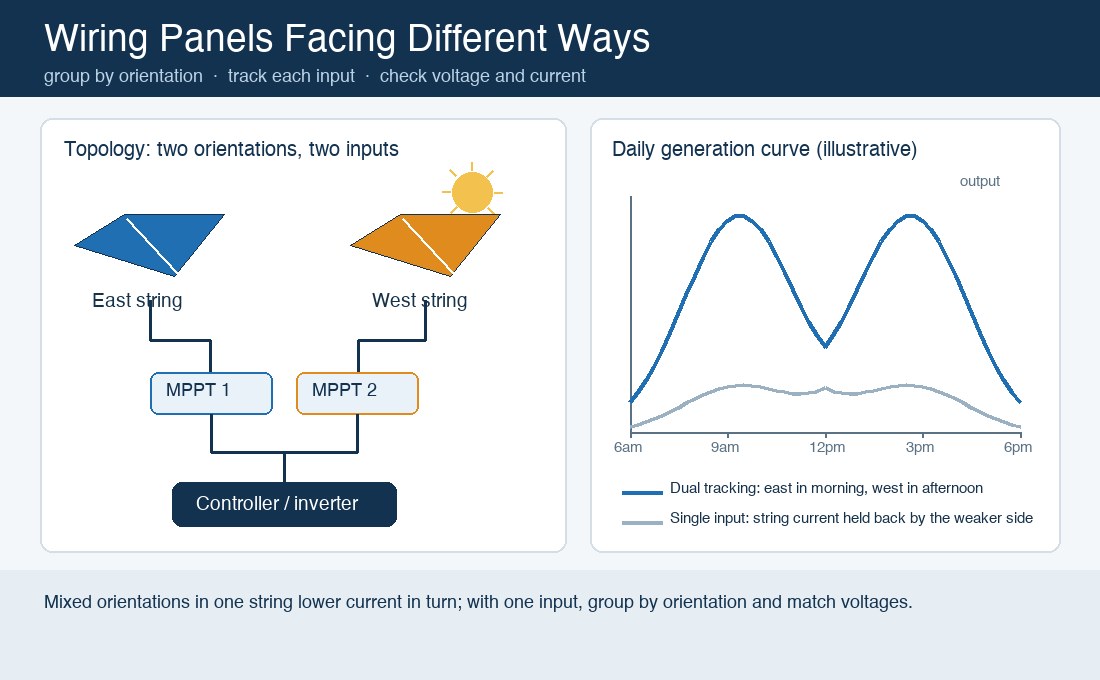 How to Wire Solar Panels Facing Different Directions
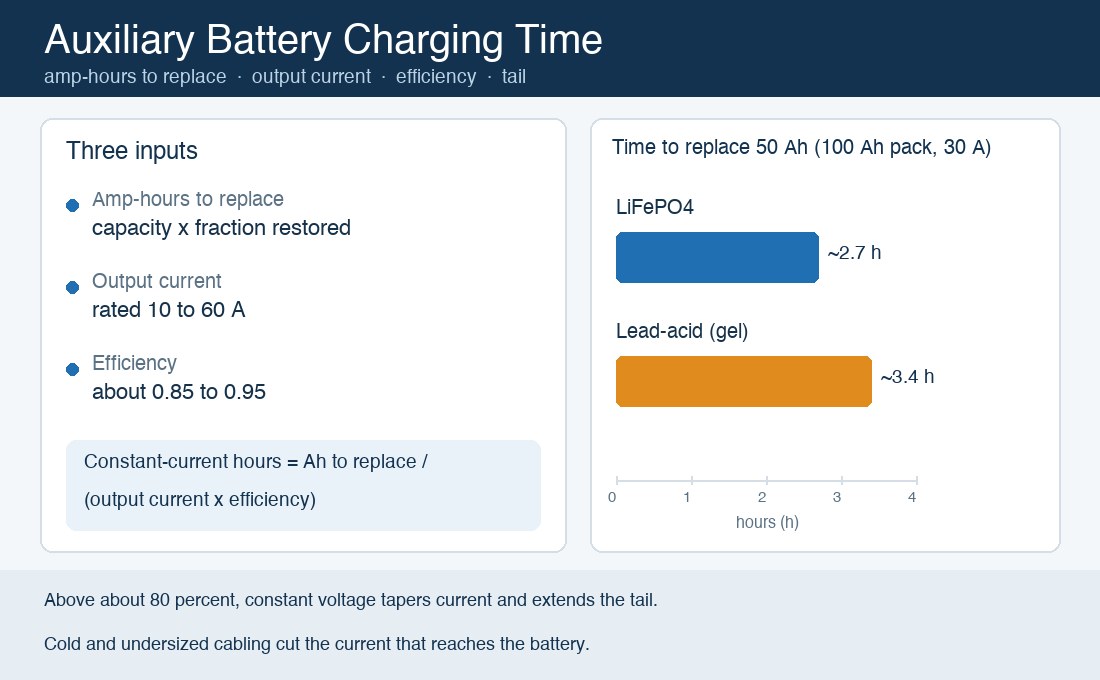 How Long Does a DC-to-DC Charger Take to Charge an Auxiliary
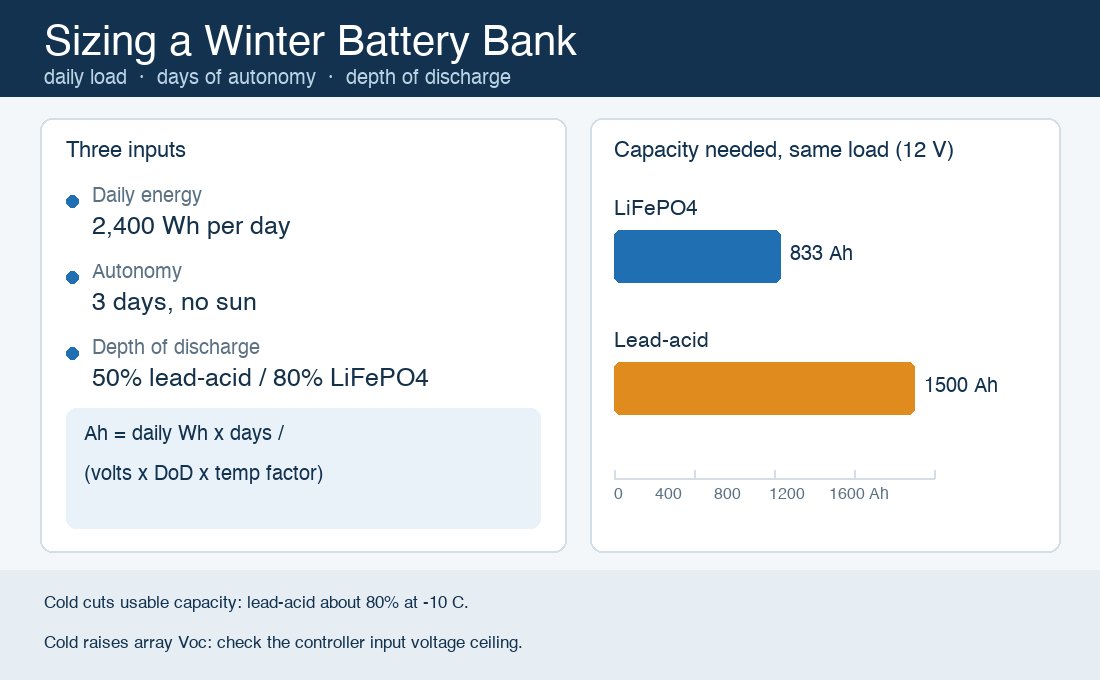 How Do You Size a Winter Battery Bank for an Off-Grid System
 Can an Inverter Run a Refrigerator? Starting Power and Runti