 简体中文
 English

How Do You Set Battery Type on an Inverter Charger?
An inverter charger is a single unit that combines an inverter, a battery charger, and an automatic transfer switch for shore power or solar input. It is used in RVs, boats, and off-grid solar systems, and the user has to set the battery type in the menu first so the unit can follow the correct charging curve.
1. Why the Battery Type Setting Changes the Charging Result
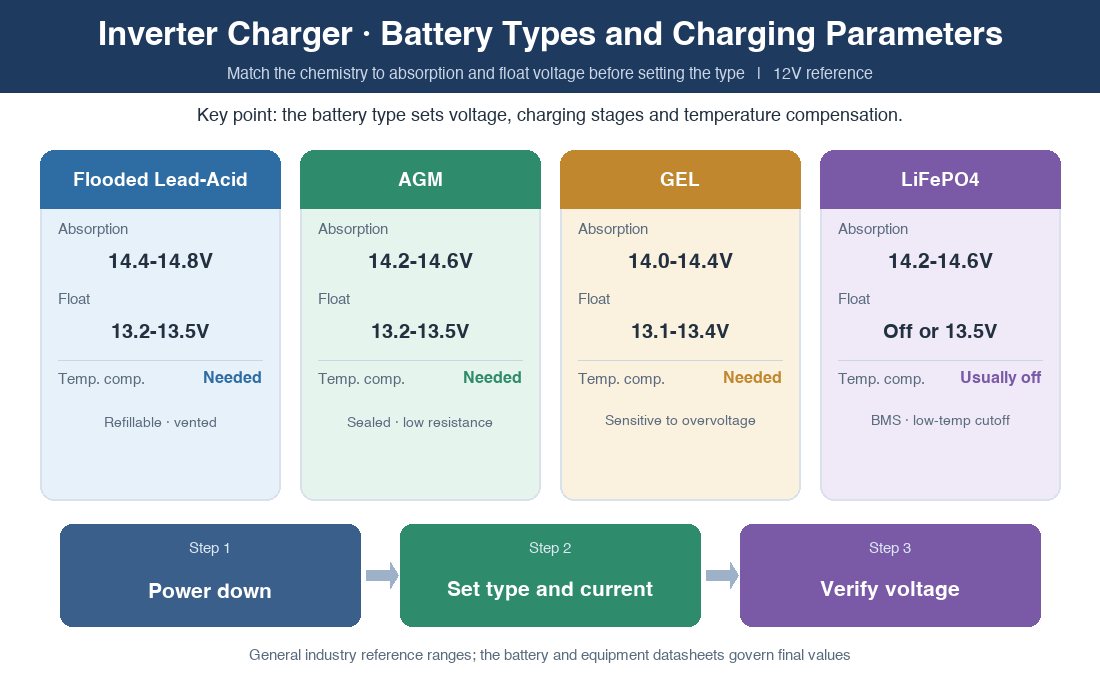
Answer: the battery type sets the charging voltage, the charging stages, and whether temperature compensation is active, so a wrong type leaves the battery undercharged or overcharged over time. An inverter charger usually ships with preset curves for flooded lead-acid, AGM, GEL, and LiFePO4, and each curve carries its own absorption voltage, float voltage, and equalization logic.
Take a common 12V system. A flooded lead-acid bank is typically charged at 14.4V to 14.8V in absorption, while a LiFePO4 bank is commonly charged at 14.2V to 14.6V and usually does not sit on a long float stage. The gap looks small on paper, yet over months it changes cycle life and usable capacity in a visible way. Setting the battery type tells the charger which chemistry to work with; it is more than renaming a field on the display.
Units with temperature compensation also adjust the charging voltage to battery temperature. Lead-acid banks commonly use a coefficient around -3mV to -5mV per degree Celsius, while LiFePO4 banks generally block charging at low temperature. If an inverter charger applies the wrong coefficient, winter and summer behavior can differ a great deal.
2. Battery Types and Charging Parameters Compared
Answer: confirm the chemistry from the battery label or datasheet, then pick the matching preset in the table below; a user-defined value takes priority over the factory default.
| Battery type | Absorption / equalize (12V) | Float (12V) | Temp. compensation | Typical traits |
|---|---|---|---|---|
| Flooded lead-acid | 14.4–14.8V | 13.2–13.5V | Needed | Refillable, lower cost, needs venting |
| AGM | 14.2–14.6V | 13.2–13.5V | Needed | Sealed, lower internal resistance |
| GEL | 14.0–14.4V | 13.1–13.4V | Needed | Sensitive to overvoltage, slower charge |
| LiFePO4 | 14.2–14.6V | Off or about 13.5V | Usually off | Needs BMS, low-temp cutoff, longer cycle life |
These figures are common reference ranges for 12V systems; a 24V system is roughly double, and the battery datasheet remains the authority. After choosing a type on the inverter charger menu, users can verify the actual terminal voltage with a multimeter to confirm that the reading matches the setting.
3. How LiFePO4 and Lead-Acid Settings Differ
Answer: switching to LiFePO4 means adjusting the voltage ceiling, the float strategy, and the low-voltage cutoff together; changing one item alone is rarely enough.
Lead-acid banks tolerate a continuous float, while LiFePO4 banks are usually better served by stopping the charge or holding a small maintenance current once full, so many inverter chargers offer a lithium mode that disables float. The discharge cutoff also differs, so a lead-acid low-voltage threshold can cause early shutdown or deeper discharge on a lithium bank. Third, battery packs with a communication port can pass BMS data over CAN or RS485; in that case the menu type is often set to custom or BMS-controlled.
Charging lithium below 0°C carries a plating risk, and packs with low-temperature protection cut the charge path on their own. In a winter RV setup, users can check whether the battery has a heating function before setting the allowed charging temperature on the inverter charger.
4. Steps to Set the Battery Type on an Inverter Charger
Answer: power down, set the values, then verify; this order reduces the chance of a live parameter change causing an unwanted action.
Step one, shut off AC input and solar input, disconnect the DC loads, and leave the unit stopped. Step two, open the battery menu on the control panel or the inverter LCD display, choose the battery type, then set the capacity in Ah, the maximum charge current, and the low-voltage cutoff; the maximum charge current is often estimated at 0.2C to 0.5C of capacity, subject to the maker's advice. Step three, restore power and watch whether the voltage rise and current taper follow the selected curve, then log one or two full charge cycles.
If the system also has an MPPT solar charge controller and a DC-DC charger, those charging sources should share the same battery parameters, or one source overcharges while another undercharges. A pure sine wave inverter converts DC to AC and does not set the charging curve, yet the menu often places inverter and charger settings on one screen, so users can check which group they are editing.
5. What You See When the Setting Is Wrong
Answer: undercharge shows up as capacity fading faster, while overcharge shows up as heat, swelling, or repeated alarms; both leave traces in the voltage log.
Setting a LiFePO4 bank to a lead-acid curve can leave the unit floating for long periods, holding the cells at a higher voltage and triggering BMS protection repeatedly. Setting a lead-acid bank to a lithium mode can end the absorption stage early, so the bank rarely fills and capacity drifts down. A flooded bank set to a GEL curve sees a lower voltage and is more prone to sulfation. On the equipment side, common signs include charge current dropping to zero early, battery voltage rebounding too fast, and over- or under-voltage codes on the panel. Reading back the battery type and checking the voltages against the datasheet usually locates the issue faster than swapping hardware.
6. Frequently Asked Questions
Do I need to reset the battery type after replacing the bank?
Yes. Absorption voltage and float strategy differ by chemistry, so keeping the old setting holds the new bank away from its rated charging state. After a replacement, users can also review capacity, maximum charge current, and the low-voltage cutoff.
If the type is correct, do I still set the charge current?
Yes. The battery type sets the voltage curve only; the current limit is set separately from capacity and the maker's advice. A large current on a small bank raises temperature, while a small limit on a large bank stretches charge time markedly.
Can the inverter charger, the MPPT solar charge controller, and the DC-DC charger each use different values?
That is not recommended. When several sources feed one bank, each can follow the same voltage and current limits from the datasheet, otherwise their decisions conflict. Users can make one source the primary charger and lower the voltage ceiling on the others to reduce contention.
The figures above are general industry references; the datasheets of the battery and the equipment govern the final values. LECOOVO operates a 4000 m² production base in Zhongshan, covers 300W to 6000W, holds CE, UL, SAA, and CCC certification, and supports OEM/ODM. If your RV, marine, or off-grid project needs specific battery presets and charging curves, please contact us to discuss a custom configuration.
 How to Wire Solar Panels Facing Different Directions
 How Long Does a DC-to-DC Charger Take to Charge an Auxiliary
 How Do You Size a Winter Battery Bank for an Off-Grid System
 Can an Inverter Run a Refrigerator? Starting Power and Runti