 简体中文
 English

What Happens If You Wire the Wrong Input Voltage to an Inverter?
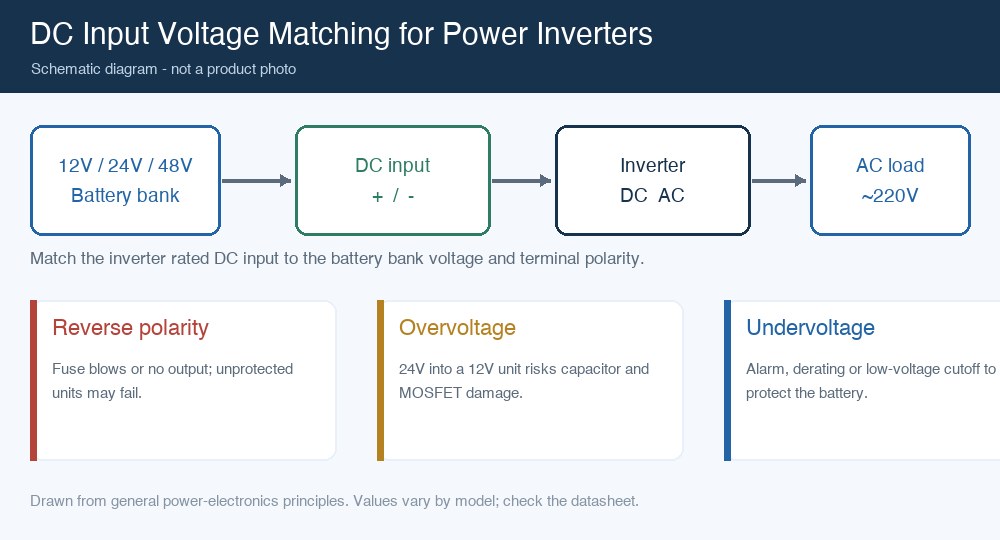
An inverter's DC input voltage rating defines which battery bank it can safely accept—most commonly 12V, 24V, or 48V—across RV power systems, off-grid solar installations, and in-vehicle applications. Connecting the wrong voltage (a higher-voltage battery to a lower-voltage unit, or vice versa) or reversing the polarity are the two most common wiring mistakes during installation, with consequences ranging from a warning shutdown to permanent damage. This guide explains what happens in each case and how to prevent it.
What Happens If You Connect a 24V Battery to a 12V Inverter
This is an overvoltage condition. Most 12V units respond with overvoltage protection: an audible alarm, a fault indicator, and no AC output, and the hardware often survives. The risk appears when the protection threshold is set high or the protection circuit fails. The DC-link filter capacitors in a 12V model are typically rated around 25V, while a fully charged 24V battery bank can exceed 28V. The capacitors then operate above their rated voltage, which leads to bulging, electrolyte leakage, or dielectric breakdown, and the front-end power transistors may fail as a result. The higher the applied voltage, the faster the damage develops.
What Happens If You Connect a 12V Battery to a 24V Inverter
This is an undervoltage condition. A 24V unit detects that the bus voltage is below its startup threshold, reports an undervoltage fault, and refuses to run; some units start but trip back into protection as soon as a load is applied. This mistake rarely destroys hardware, but repeated undervoltage restarts subject the battery to frequent high-current surges, which is hard on battery life. Wiring two identical 12V batteries in series to form 24V is a common solution, provided both batteries share the same model, capacity, and age—mismatched batteries charge and discharge unevenly and degrade faster.
What Happens If You Reverse the Polarity
The outcome depends on whether the unit includes reverse polarity protection. On a protected design (typically a reverse-blocking diode arrangement with an input fuse), reversing the terminals usually blows the input fuse instantly, and the unit recovers once the fuse is replaced. On an unprotected unit, or one where the fuse is oversized or missing, reversed polarity creates a high-current loop: arcing at the battery terminals, overheated cables, and shorted capacitors and switching transistors on the input stage. The DC input section of the unit may be written off entirely, and a battery-side short circuit can reach hundreds of amps, creating burn and fire hazards.
Comparison of Common Wiring Mistakes
| Wiring mistake | Typical response | Possible damage | Recommended action |
|---|---|---|---|
| 24V battery into a 12V inverter | Overvoltage alarm or forced operation | Overstressed DC-link capacitors; failed power transistors | Disconnect immediately; retest on a 12V bank; service if it won't start |
| 12V battery into a 24V inverter | Undervoltage alarm; no startup or trips under load | Rarely destructive; repeated surges stress the battery | Series two identical 12V batteries to reach 24V |
| Reversed polarity (with protection) | Input fuse blows instantly | Usually the fuse only | Correct polarity; replace with the same fuse rating |
| Reversed polarity (no protection) | Arcing at terminals; no output | Shorted input capacitors and transistors; input stage destroyed | Stop using the unit; have the DC input stage inspected |
A Four-Step Check Before Wiring
First, verify the DC input range on the nameplate and in the manual, and confirm whether the unit is a 12V, 24V, or 48V model. Input ratings differ across product types—a pure sine wave inverter, an inverter-charger, a DC-DC charger, and an MPPT solar charge controller each have their own specification, so appearance alone tells you nothing. Second, measure the battery terminals with a multimeter on the DC voltage setting; the probe on the positive terminal should read a positive voltage. Third, connect the positive cable first and the negative cable last, and reverse the order when disconnecting, so a metal tool cannot short the circuit against the chassis. Fourth, use red cable for positive and black for negative, label the terminals, and mark the series link in multi-battery banks so future maintenance stays unambiguous.
Frequently Asked Questions
Q: I connected a 24V battery to my 12V inverter by mistake. Can I still use it?
A: If the unit tripped its overvoltage protection immediately and you disconnected quickly, there is usually no hardware damage, and it should start normally once wired to a 12V bank. If the fuse has blown or the unit shows no sign of life, the input stage may be damaged and needs inspection before further use.
Q: Reversed polarity blew the fuse. Can I just fit a new one?
A: Correct the polarity first and re-measure the battery voltage with a multimeter, then install a replacement fuse of the same type and current rating. If the new fuse blows immediately, an internal short already exists, and swapping fuses repeatedly will only make the fault worse.
Q: How can wiring mistakes be avoided altogether?
A: Choose models that include reverse polarity, overvoltage, and undervoltage protection; make "check the nameplate, measure the voltage, separate the colors, label the terminals" a standard habit. For fleet or system-integration purchases, ask the manufacturer to reinforce polarity markings on terminals and in documentation.
LECOOVO operates a 4,000 m² production base in Zhongshan, China, manufacturing pure sine wave inverters, inverter-chargers, and DC-DC chargers from 300W to 6000W with CE, UL, SAA, and CCC certifications. Overvoltage, undervoltage, and reverse polarity protection are built into the input stage, and OEM/ODM customization is supported. If you have questions about input voltage ratings, battery matching, or volume orders, please contact us for selection advice.
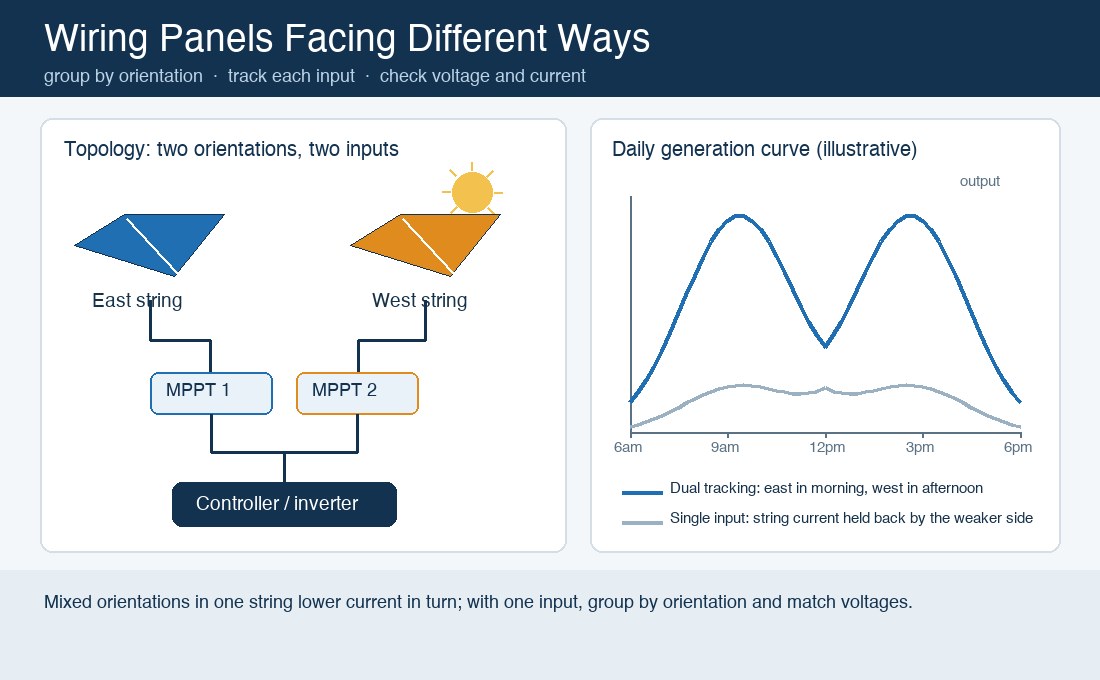 How to Wire Solar Panels Facing Different Directions
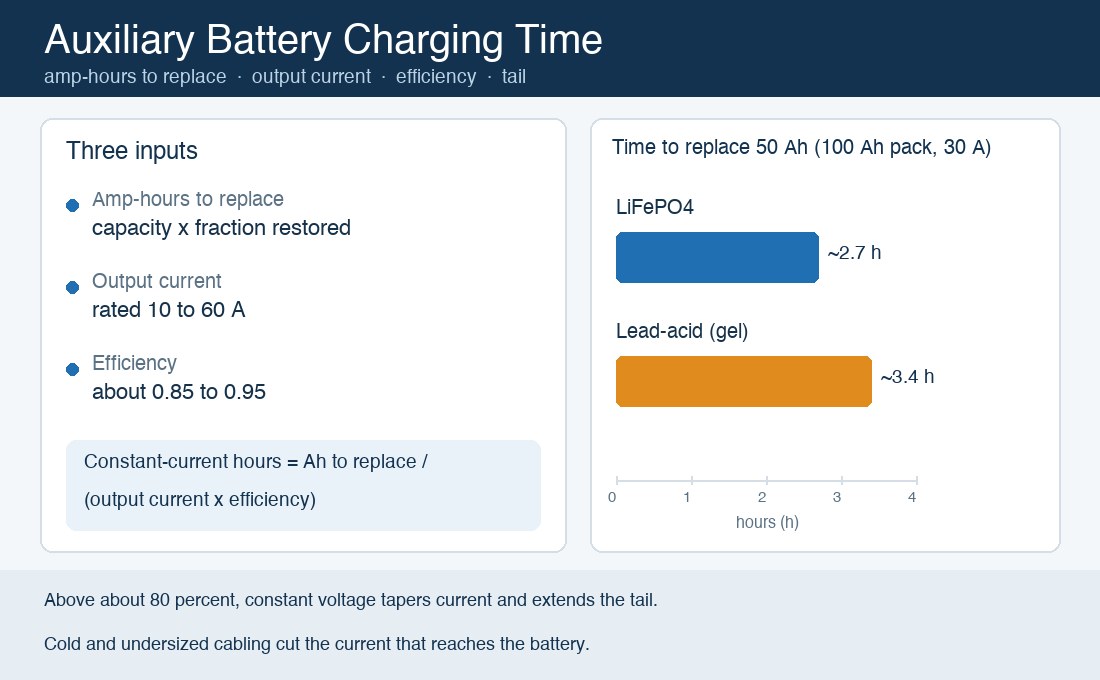 How Long Does a DC-to-DC Charger Take to Charge an Auxiliary
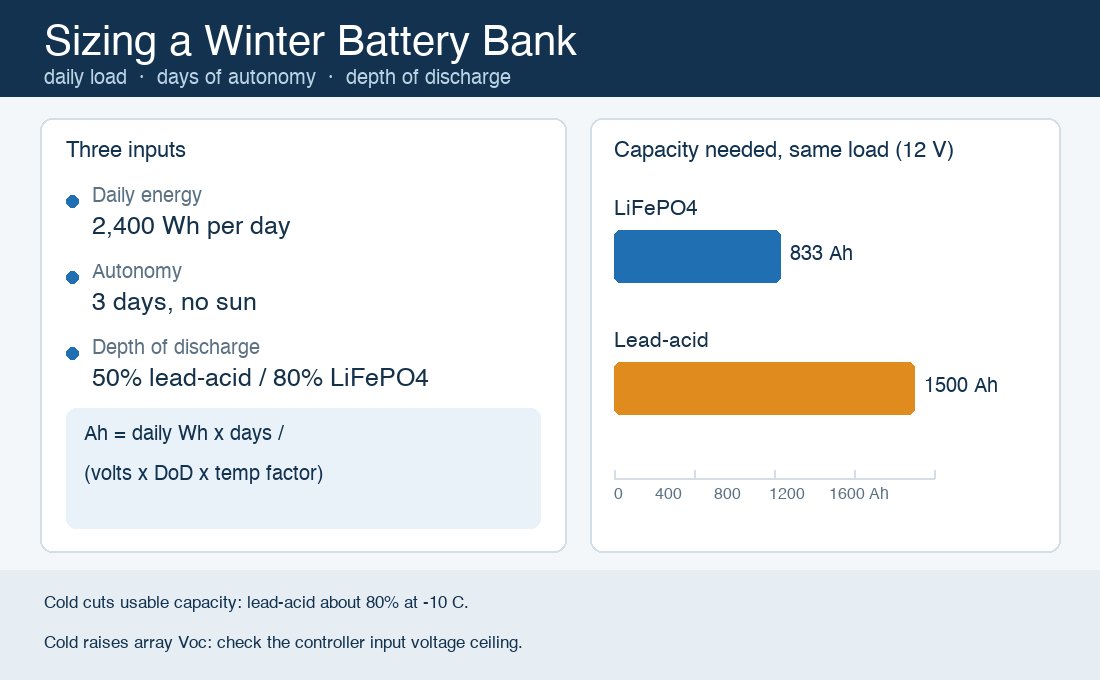 How Do You Size a Winter Battery Bank for an Off-Grid System
 Can an Inverter Run a Refrigerator? Starting Power and Runti