 简体中文
 English

How Do You Apply for CE Certification for an Inverter?
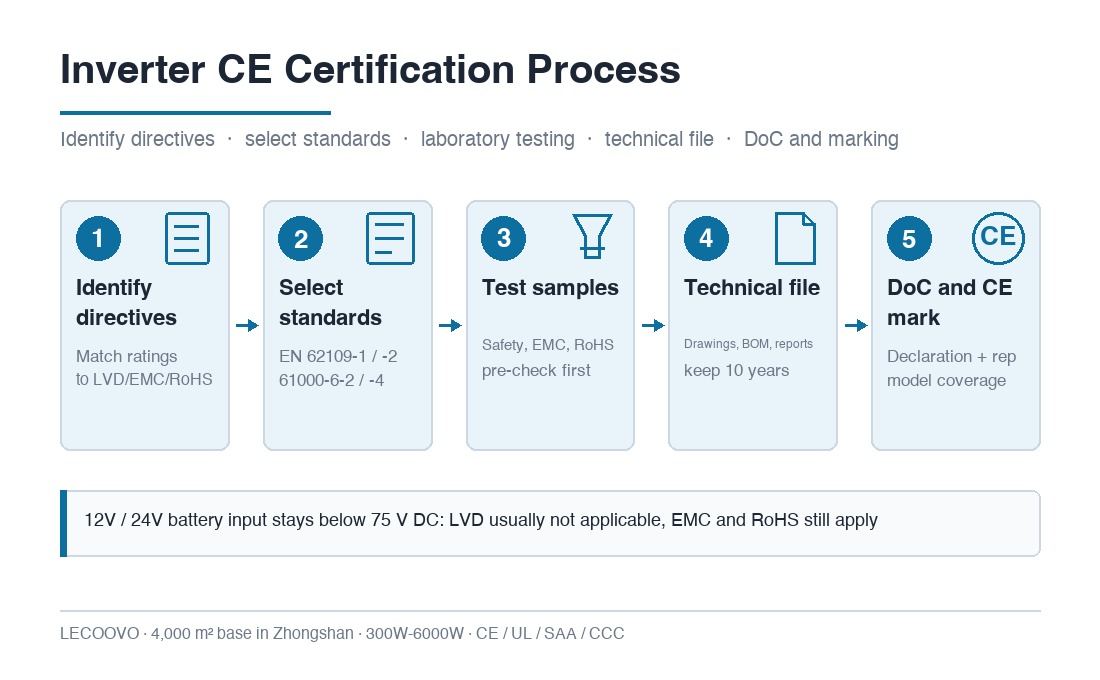
Inverter CE certification is the compliance process in which a manufacturer assesses an inverter for electrical safety and electromagnetic compatibility against the EU Low Voltage Directive, the EMC Directive and the RoHS Directive, signs an EU Declaration of Conformity, and affixes the CE mark; it applies to every inverter placed on the EU and EEA market, including car inverters, pure sine wave inverter models and off-grid solar units.
1. What the CE mark actually obliges
The CE mark is not a quality certificate issued by a third party. It is the manufacturer's declaration that the product meets the applicable EU legislation. Once the mark is applied, the manufacturer remains responsible for conformity across the product lifetime, while importers and the EU authorised representative share the duty of cooperating with market surveillance. When authorities inspect under Regulation (EU) 2019/1020, they ask for the technical file and the Declaration of Conformity, not a test report alone.
So judging whether an inverter is genuinely CE compliant takes more than reading the silk-screen on the enclosure. Check whether a signed DoC travels with the shipment, and whether the directive numbers cited in it match the product's actual functions.
2. Identify the applicable directives first
The input and output ratings determine which directives apply. Settle this layer first, because everything downstream depends on it. The common combinations are listed below.
| Legislation or standard | When it applies | Typical assessment |
|---|---|---|
| LVD 2014/35/EU | Equipment rated 50–1000 V AC or 75–1500 V DC | Insulation and creepage, temperature rise, mechanical strength, protection against electric shock |
| EMC 2014/30/EU | Equipment that may generate or be affected by electromagnetic disturbance | Conducted and radiated emissions, ESD and surge immunity, burst immunity |
| RoHS 2011/65/EU (with 2015/863) | All electrical and electronic products | Limits for lead, cadmium, mercury, hexavalent chromium, polybrominated biphenyls |
| EN IEC 62109-1 and -2 | Power converters for photovoltaic systems | Constructional safety, clearances, fault conditions, grid protection |
| RED 2014/53/EU | Models with Bluetooth or WiFi monitoring | Radio parameters, spectrum use, coexistence |
A 12 V or 24 V battery-input model sits below 75 V DC on the input side, so the LVD usually does not apply, yet EMC and RoHS still do. Some buyers additionally require an EN IEC 62109 safety assessment; in that case it is a contractual term rather than a legal obligation. In camper and off-grid installations, an inverter often shares the same cabinet with an MPPT solar charge controller and a DC-DC charger, so splitting the system into separate certified models, each with its own report, keeps the schedule manageable.
3. How to arrange the testing stage
Once the directives are fixed, map them to the harmonised standards and book a laboratory with the right scope. PV inverters are normally assessed against EN IEC 62109-1 for general safety and EN IEC 62109-2 for inverter-specific requirements, while EMC follows EN IEC 61000-6-2 and EN IEC 61000-6-4, or the relevant product family standard.
Before shipping samples, check three things internally: the nameplate matches the user manual; over-voltage, under-voltage, over-temperature and short-circuit protection actually operate; the enclosure and terminals meet the IP rating claimed in the manual. These three items cause most retests and rejections, and clearing them early saves a round trip.
4. Building the technical file and the DoC
The technical file usually contains product drawings and circuit schematics, a critical component list with certificates, the nameplate and user manual, a risk assessment, test reports, and records of internal production control. It must be kept for ten years after the last unit is placed on the market and made available to market surveillance authorities.
The Declaration of Conformity states the manufacturer's name and address, the model and batch identification, the directives and standard versions cited, and the signatory with the date. Model coverage has to be explicit: within one family, a difference limited to power devices can be covered by a family report, while a change in topology or safety construction requires a separate assessment.
5. Common rejection causes and how to avoid them
Rejected submissions tend to fall into four groups. The first is a mismatch between the nameplate and the manual, for example a 3000 W marking against a manual that states 2000 W continuous output. The second is a DC-side safety assessment that skipped EN IEC 62109-1, leaving no record of reverse-polarity or dielectric withstand testing. The third is an EMC report citing a standard version that has since been superseded. The fourth is a DoC that was never updated and still names the old standard.
The practical answer is to treat certification as part of the design loop rather than paperwork before shipment. For a line spanning 300 W to 6000 W, submit representative models in power bands first and extend coverage afterwards, which controls cost and makes derivative models easier to reuse.
6. Frequently asked questions
Does a CE certificate expire?
There is no single expiry date for CE. Compliance depends on the standard versions cited and on whether the design changed, so a standard revision or a critical component swap calls for reassessment. Most purchase contracts ask for an updated report every two to three years.
Can CE be self-declared without a notified body?
Yes. The LVD and EMC directives allow internal production control and self-declaration without a notified body. For models with a radio module, self-declaration under RED is also possible when harmonised standards cover the testing. A notified body usually enters when standards do not fully cover the product, or when the buyer specifies a third-party report.
Are CE reports from Chinese laboratories accepted in the EU?
The EU does not designate laboratories; it requires traceable test capability and verifiable reports. If the laboratory holds CNAS or ILAC accreditation covering the relevant standards, the report can form part of the technical file. Market surveillance may still request additional testing or a retest.
If you need CE documentation for a car, camper or off-grid solar project, or want the certification set adjusted for a target market (CE, UL, SAA, CCC), contact us with your power range and application. LECOOVO operates a 4,000 m² production base in Zhongshan, covers 300 W to 6000 W, and supports OEM/ODM work including samples and technical files.
 How to Wire Solar Panels Facing Different Directions
 How Long Does a DC-to-DC Charger Take to Charge an Auxiliary
 How Do You Size a Winter Battery Bank for an Off-Grid System
 Can an Inverter Run a Refrigerator? Starting Power and Runti