 简体中文
 English

How Does OEM Customization of Power Inverters Work?
OEM customization of a power inverter is a cooperation model in which the buyer defines power rating, input voltage, output waveform and enclosure requirements, and the inverter manufacturer designs and builds the unit under the buyer's own brand. It is widely used by e-commerce brands, RV conversion workshops and off-grid solar integrators that source a pure sine wave inverter, an MPPT solar charge controller or a combined inverter-charger.
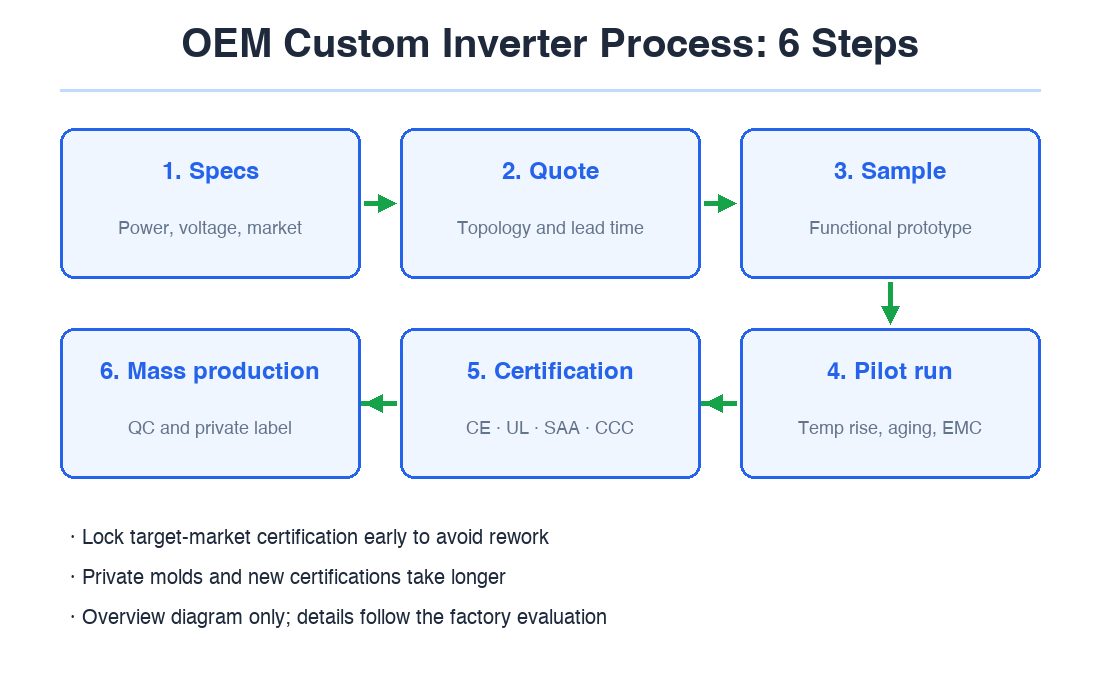
This article follows the order in which a project actually moves: the six stages of OEM/ODM work, the parameters to settle during specification review, and the way sampling, certification and lead time affect each other.
1. OEM and ODM: what is the difference
In an OEM arrangement the buyer owns the design and specification and the factory builds to that specification. In an ODM arrangement the factory offers an existing platform, the buyer selects a model and applies its brand, and may request changes to silkscreen, packaging and connector positions. Buyers who already hold a circuit design and a certification plan usually fit OEM better; buyers who want a shorter time to market and lower development spending usually find ODM faster. The two models can be used in sequence: start with ODM, then move to OEM once volume is stable and differentiation matters.
2. The six stages of a customization project
A disciplined project follows the sequence below. Each stage has a deliverable, and skipping one pushes risk into a later stage.
- Specification review: fix rated power, input voltage, output standard, load type and target market.
- Evaluation and quotation: engineers check topology, device margin and mechanical space, then quote price and lead time.
- Sampling: build a functional prototype and verify efficiency, waveform distortion and protection behaviour.
- Testing and pilot run: run temperature-rise, burn-in and pre-compliance EMC checks, and confirm the process repeats.
- Certification: submit samples for the destination market and obtain CE, UL, SAA or CCC approval.
- Mass production and shipment: batch consistency sampling, private-label packaging and shipping documents.
Waiting time between stages comes mainly from component procurement, tooling progress and the certification queue. A project schedule should list those three items separately instead of quoting a single total lead time.
3. Parameters to provide during specification review
The more specific the requirement sheet, the closer the quotation comes to the real cost. The table below lists the items that matter most.
| Parameter | Typical options | Effect on cost and lead time |
|---|---|---|
| Rated power | 300W to 6000W | Higher power raises device and heatsink cost |
| Input voltage | 12V / 24V / 48V | Drives switch and transformer selection; a step change needs redesign |
| Output waveform | Pure sine / modified sine | Pure sine uses more devices and costs more, with better inductive-load compatibility |
| Output standard | 110V/220V, 50Hz/60Hz | Set by target market; each standard is certified separately |
| Enclosure and print | Open mold / private mold, branding | A private mold adds tooling cost and longer lead time |
| Certification | CE / UL / SAA / CCC | Approval takes weeks to months; a circuit change means retesting |
Beyond the table, describe the load type (motor, compressor, resistive), ambient temperature and humidity, whether a DC-DC charger or an inverter-charger is part of the package, and the expected annual volume. These details drive component grade and the structure of the quotation: larger volumes lower the unit cost, while sampling and small batches carry a higher unit price than mass production.
Keep one-off costs separate from the unit price. Tooling and certification fees are paid once and are not repeated on a repeat order, whereas the unit cost changes with volume; combining the two hides which part of the quote can be negotiated.
4. What sampling, testing and certification must prove
Three points dominate the sample review: efficiency and output distortion at rated load, correct operation of every protection function, and temperature margin on key components. Overload, short circuit, over-temperature and under-voltage protection should each be tested with the trip point recorded. If the destination market regulates electromagnetic compatibility, run a pre-compliance EMC scan on the prototype so that certification does not force a mold change later.
Certification follows the sales territory: CE for the European Union, UL or ETL for North America, SAA for Australia, CCC for domestic sale. Approval requires samples from a frozen design, and any change to creepage distance, safety-critical components or nameplate data must be reassessed. Writing certification into the project schedule, and reserving sample quantity and document time as the certification body requires, costs less time than testing reactively before mass production.
5. Frequently asked questions
Q1: Can we start OEM customization without a full specification?
Yes. Describe the application, load type, input source and target market, and the factory engineers can help turn that into a specification before power and protection parameters are confirmed. Freezing the specification before sampling reduces rework.
Q2: How long does an OEM project usually take?
Projects limited to an existing mold, branding and packaging are shorter. Projects that involve a private mold, a circuit revision and new certification run longer, typically counted in months. The exact schedule depends on design complexity and certification queueing, and should be confirmed by the factory's evaluation.
Q3: Can we change only the enclosure and packaging?
Yes. This light form of customization covers shell colour, silkscreen, manual and packaging, so it needs less validation and a shorter lead time, which suits a brand at launch. Deeper circuit and function customization can follow once volume is stable.
6. Contact us
LECOOVO operates a 4,000 m² production base in Zhongshan, covers a power range of 300W to 6000W, holds CE, UL, SAA and CCC approvals, and supports OEM/ODM work on pure sine wave inverters, MPPT solar charge controllers, inverter-chargers and DC-DC chargers. To evaluate a customization plan or request a sampling quotation, contact us and our engineers will propose a configuration for your application.
 How to Wire Solar Panels Facing Different Directions
 How Long Does a DC-to-DC Charger Take to Charge an Auxiliary
 How Do You Size a Winter Battery Bank for an Off-Grid System
 Can an Inverter Run a Refrigerator? Starting Power and Runti